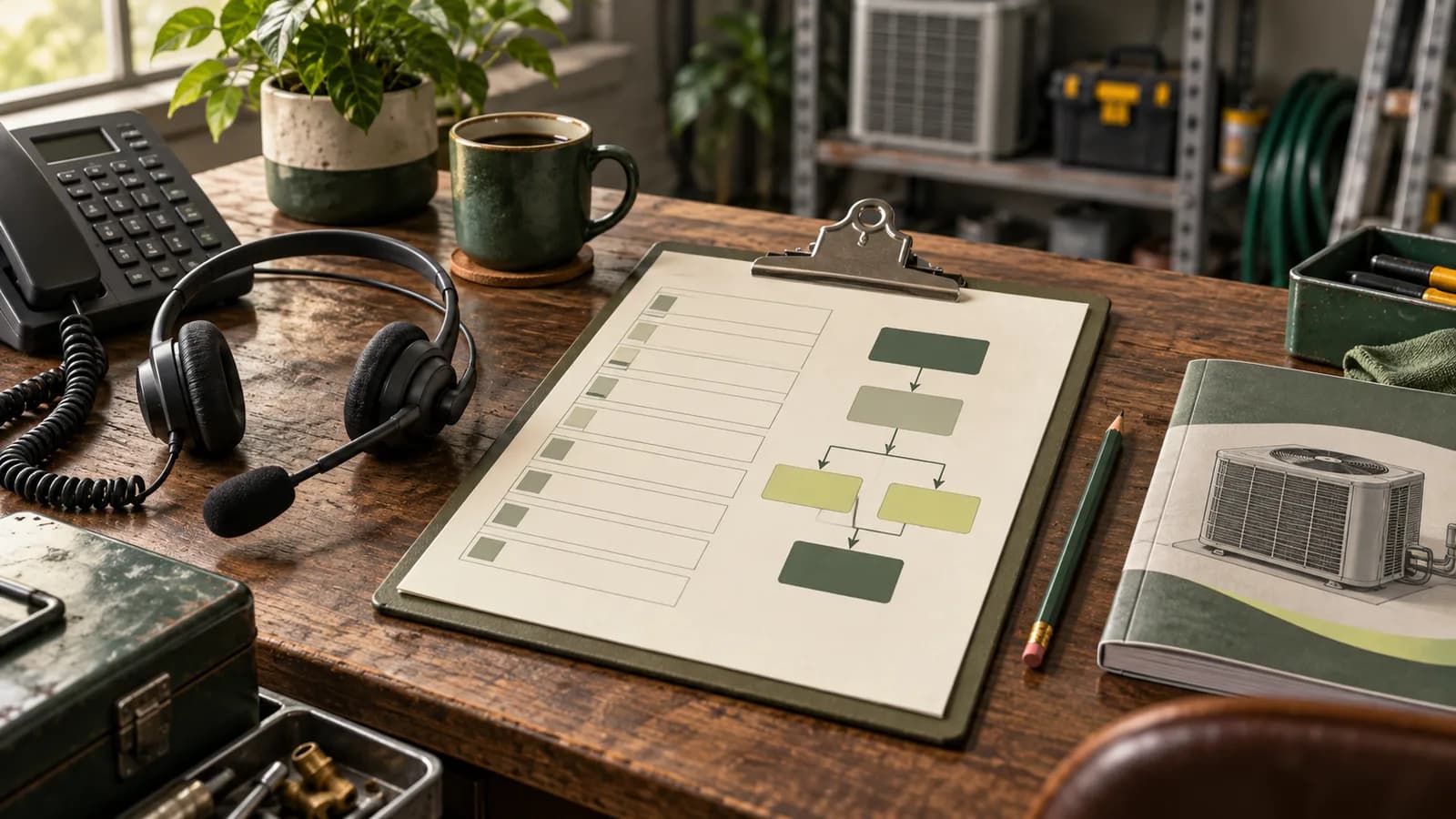
Decide exactly when the after-hours workflow begins
After-hours coverage should have an observable start and stop. Define whether it begins at closing time, after a ring timeout, when the office line is busy, or only on specific nights and holidays. The caller should not bounce between multiple systems with no owner.
If the office is open but every line is occupied, use the HVAC call-overflow plan to define the busy-hour route and callback queue.
For the first pilot, use conditional forwarding so the HVAC company keeps its public number and the office remains the primary front desk. That makes the incremental results easier to measure and gives staff a direct fallback while the rules are still being tuned.
Collect the minimum facts that change the next step
The receptionist needs enough information to route the request, but an anxious caller should not face a long interview. Ask for the service location and plain-language need before collecting details that do not affect eligibility or escalation.
Turnline's HVAC starting point is a caller name, callback number, exact postal code, service need, urgency, and property type. The business must decide which additional fields are truly required for its dispatch process.
- Caller name and reliable callback number
- Exact service address or approved postal-code check
- Plain-language heating, cooling, maintenance, or other request
- What the caller reports about current operation and urgency
- Property type and new-versus-existing customer status when relevant
- The next step the caller was actually told to expect
Write an escalation ladder that can fail honestly
The receptionist should collect reported facts and follow approved language; it should not diagnose equipment or decide that a situation is safe. Define the conditions that stop ordinary intake and require a person, along with the primary destination, backup destination, timeout, and caller-facing fallback.
An attempted transfer is not a completed handoff. Record success only after the provider confirms the connection. When nobody accepts, create a visible callback task and tell the caller what will actually happen next.
Separate a booking request from a confirmed appointment
A requested time window is not confirmed merely because it sounded available in conversation. Define which service types, coverage areas, hours, buffers, memberships, deposits, and technician constraints must be checked before an appointment can be promised.
Keep the first version at request-only when those checks are not connected to a verified calendar. The morning dispatcher should see the requested window, the facts used to qualify it, and any remaining confirmation work.
Make the next-day queue operational
Every unresolved call needs one status, one owner, and one deadline. Group the queue into booking requests, callbacks, unsuccessful transfers, unsupported work, and out-of-area requests so the office can act without replaying every conversation.
When an operator claims an item, the system should show who owns it. Completion should require confirmation that the outside action really happened; releasing or failing an item should preserve an audit trail instead of silently removing it.
- New request with complete intake
- Waiting for appointment confirmation
- Human callback due
- Transfer attempted but not connected
- Outside service area or unsupported work
- Resolved with the actual outcome recorded
Test the bad paths before forwarding customer traffic
A polished demo proves little about the calls that create operational risk. Run controlled scenarios for in-hours and after-hours requests, missing information, unsupported work, exact coverage, requested humans, successful and failed transfers, repeated provider events, and an unavailable downstream system.
Review the transcript and resulting task for every scenario. The workflow is ready to expand only when it stays within the approved rules, makes no unsupported promise, reuses duplicate events safely, and leaves the office with an accurate next step.
Review your after-hours workflow with Turnline
Use this checklist to prepare your service-area rules, coverage window, and callback ownership. Bring one routine request and one difficult exception so the review starts with the work your dispatch team needs.
Request an HVAC pilot review with Turnline. A request starts a fit review. Pilot scope and live-call setup require separate approval.
Frequently asked questions
What information should an after-hours HVAC receptionist collect?
Start with the callback number, exact location or coverage check, plain-language service need, reported urgency, relevant property context, and the next step communicated to the caller. Add fields only when they change routing or dispatch.
Should an after-hours receptionist diagnose HVAC emergencies?
No. It should collect the caller's report, use the HVAC company's approved language, and follow explicit human-escalation rules. Technical diagnosis and safety judgment remain with qualified people and emergency services where appropriate.
Can the receptionist confirm an HVAC appointment?
Only when a verified scheduling workflow checks the company's actual service, coverage, hours, availability, buffers, and recovery rules. Otherwise it should create a clearly labeled booking request for the office.