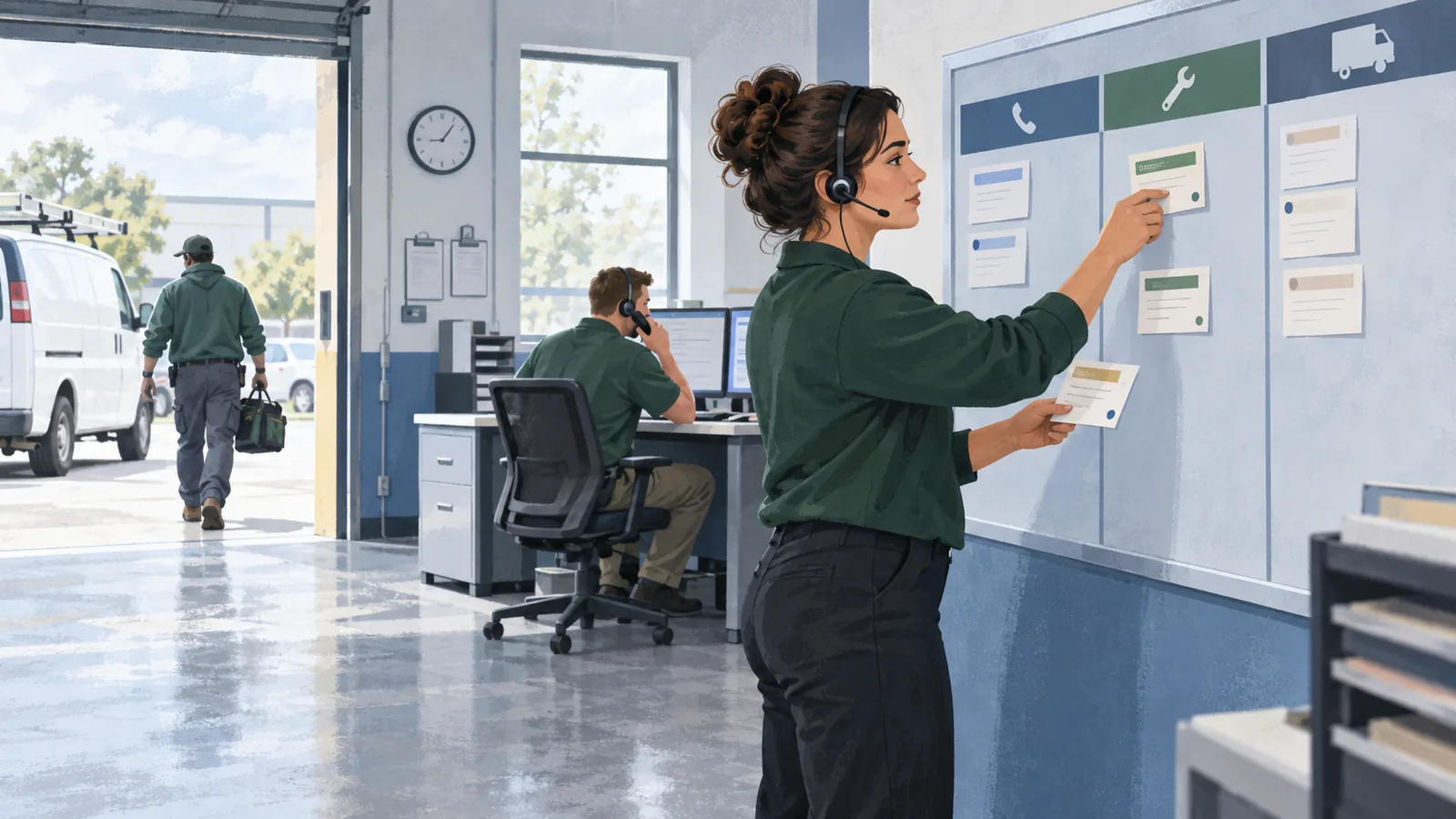
Acknowledge the call and make the reply someone's job
An HVAC missed-call text back should identify the business, acknowledge the missed call, and offer a real next step. It also needs a staffed reply path. A fast automatic text is not useful if the customer answers and nobody reads it.
Use after your contact-permission checks: “Hi, this is [Company]. We missed your call. Would you like [office/team] to call you about your service request? Our next staffed response window is [verified window].”
Download the text-back planning sheet for triggers, reply ownership, and rehearsal cases.
This is an original workflow template for an HVAC office, not a claim that Turnline currently supplies outbound SMS. Plan the whole conversation alongside your busy-hour call coverage, including what happens when the customer calls back instead of texting.
Define which missed calls qualify
Write down the actual call outcomes your phone system exposes: unanswered, busy, voicemail, abandoned in a queue, or answered by another route. Test those labels against real controlled calls. An office answering on a second line should not leave the customer receiving an inaccurate “we missed you” message.
- Check the business's approved permission and messaging process before sending.
- Exclude numbers that cannot receive texts, suppressed contacts, internal tests, and obvious spam.
- Set a repeat-call rule so three attempts about one request do not trigger three identical messages.
- Cancel a queued acknowledgment if staff have already resolved that request.
- Use different response-window wording when the office is closed.
Do not treat an inbound call as blanket permission for promotions. Keep marketing campaigns separate from the service response. Before enabling automated texts, have the person responsible for messaging review applicable consent, carrier, and opt-out requirements for the actual setup. This planning sheet is not a compliance certification.
Use wording that matches the current staffing
During a staffed callback window
“Hi, this is [Company]. Sorry we missed your call. [Office role] can follow up during [approved response window]. What kind of service were you calling about? Reply here or call [business number]. [Approved opt-out wording].”
When the office is closed
“You've reached [Company] outside office hours. This text inbox is reviewed [actual staffed hours]. You can leave a service request here for that team. This does not reserve a visit. [Approved urgent-contact instructions and opt-out wording].”
When a person takes over
“This is [Name] with [Company]. I have your request about [brief service description]. May I call you at [verified number] during [agreed window] to check the next step?”
Replace every bracket before use. If the office cannot meet a stated response window, change the workflow and the message together. Do not promise “right back” simply because it sounds friendly. A text reply should not announce that a technician is on the way unless dispatch has verified that fact.
Give each reply a clear destination
| Reply | Office action | Record |
|---|---|---|
| “Please call me.” | Assign a callback through the verified contact process. | Owner and promised window. |
| “I already spoke to someone.” | Find the existing request and stop duplicate outreach. | Linked request and actual status. |
| A reported safety concern | Use approved escalation and safety language; do not troubleshoot by text. | Reported facts and the handoff outcome. |
| “Wrong number” or a stop request | Stop the messaging path and apply the approved suppression process. | Contact correction or suppression. |
| No reply | Follow the limited, approved contact plan. | Attempted contact, not a recovered lead. |
Use a named person during each coverage window, with a backup when that person is unavailable. A shared inbox can be the workspace, but it cannot be the owner. Do not send an unattended text conversation through a long questionnaire while a time-sensitive concern waits for review.
Test the repeat caller before switching it on
In this fictional rehearsal, a customer calls at 10:01 and again at 10:03. The first call is missed; staff answer the second. A text scheduled after the first attempt should be stopped or reconciled with the answered call, depending on the supported system. The customer should have one coherent conversation with the office.
Now test an undeliverable number, a stop reply, an after-hours message, and a reply received after a staffing handoff. Watch the actual phone and the office record. A provider accepting a message does not prove it reached the handset, and handset delivery does not prove someone read it.
If the messaging system is unavailable, retain the missed-call task for the approved phone callback route. Make the failure visible to the office instead of showing the request as handled because an automation attempted to run.
Measure conversations and completed work separately
For one defined period, count eligible missed callers, messages attempted, verified delivery where available, replies, qualified service requests, confirmed appointments, completed jobs, and staff handling time. Deduplicate callers about the same request. Report opt-outs and complaints alongside the useful outcomes.
Turnline's HVAC review focuses on the intake and follow-up decisions around these calls. Bring your current phone route, staffed response window, and reply rules to an HVAC pilot review with Turnline. SMS availability and any required connection must be confirmed during scoping. For a fuller office handoff, use the dispatch checklist.
Frequently asked questions
What should an HVAC missed call text say?
Identify the business, acknowledge the missed call, ask for one useful next detail, and state the next action your office can support. Do not suggest a technician is on the way unless the visit is confirmed.
Who should handle replies?
Assign a person or staffed queue, including backup coverage and a review deadline. A message can start a conversation, but someone still needs to read and resolve the response.
Should repeat calls create separate requests?
Check whether the caller is following up on an existing request first. Preserve attempts and new information in the same record when they concern the same job.
Does Turnline currently provide this text-back workflow?
This article is an office planning template, not a claim of an activated SMS feature. Bring the missed-call and reply process to an HVAC pilot review so supported channels and scope can be defined.