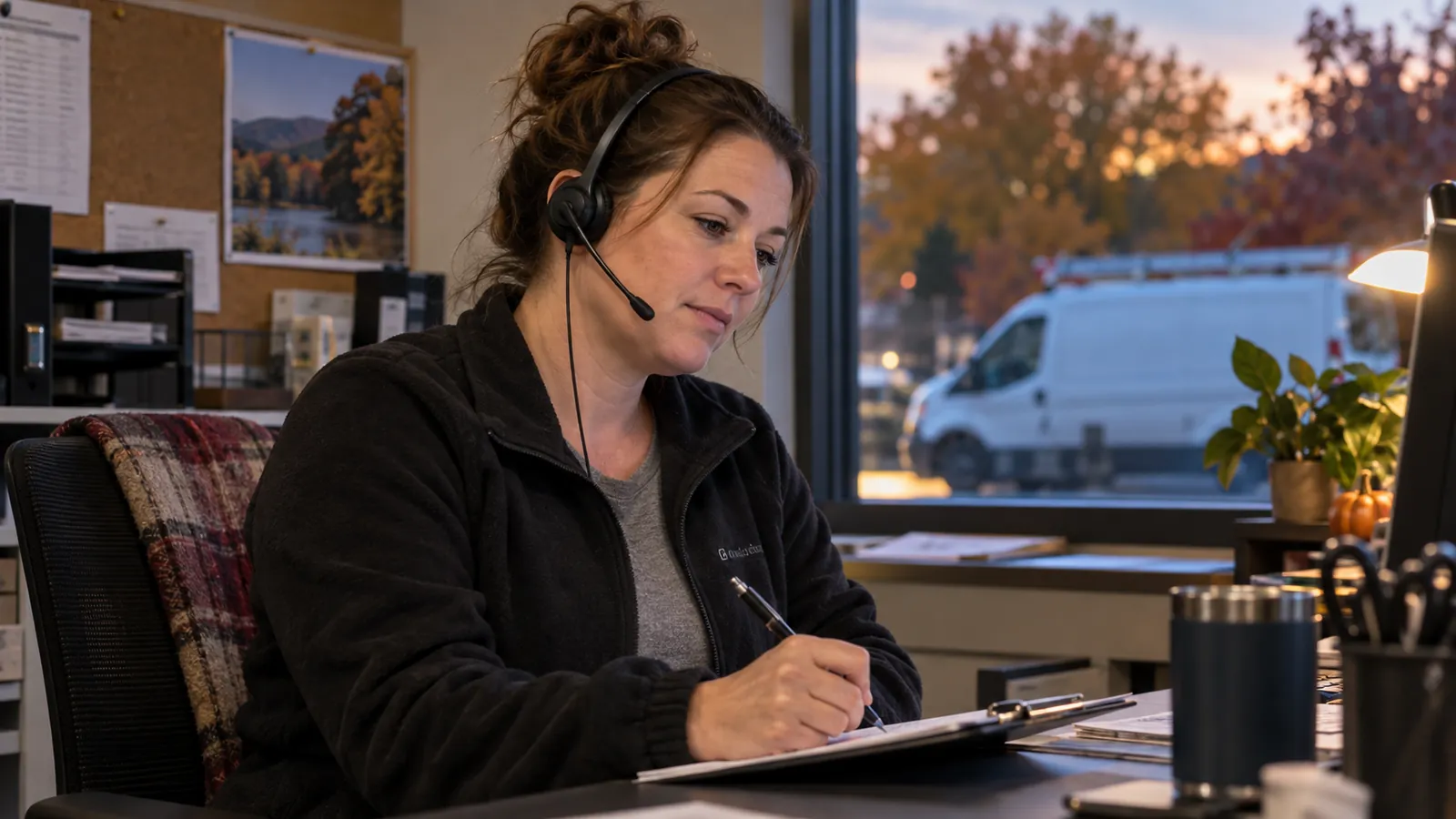
Capture the report without diagnosing the problem
HVAC no-heat call intake should give the office a reliable callback, a checked service location, the caller's report, and an approved next action. If a reported condition triggers your company's safety or urgent-escalation policy, use that path immediately. The receptionist should not decide that the property is safe or tell the caller how to repair the equipment.
Prepare before your next busy heating day: download the no-heat intake and escalation review sheet. Have your qualified operations lead supply the safety language and routing triggers.
This guide is for HVAC owners and dispatch teams. It is not homeowner troubleshooting advice. It expands the heating-specific handoff inside the broader after-hours call checklist.
Approve the routing rules before the busy period
A seasonal call script needs a current policy owner, review date, staffed coverage windows, and approved primary and backup contacts. Check whether your service area and supported equipment differ after hours. A daytime promise should not quietly carry into a night when no qualified person is available.
Keep escalation instructions separate from routine scheduling questions. The approved policy should define when normal intake stops, what the receptionist says, what destination is used, and what happens if nobody accepts the handoff. Do not ask staff to invent those decisions while a worried customer waits.
Use examples to train recognition of the policy's triggers, not to create a diagnostic decision tree. If a caller reports smoke, an alarm, an odor, or a concern outside the written branches, follow the business's approved safety and escalation instructions. Collect only the information that path requires and leave technical judgment to qualified people.
Ask short questions that change the office's next step
For a call that proceeds through routine intake under the approved policy, start with the customer's own description. “No heat” can refer to the whole property, one area, an intermittent issue, or a request for an update on an existing job. Those distinctions help the office route the request without proving a cause.
- Contact: “What number should our office use to reach you about this request?” Read it back through the approved verification process.
- Location: “What is the service address?” Check the actual territory, including any after-hours restrictions.
- Report: “Please describe what is happening and when you first noticed it.” Record observations without translating them into a diagnosis.
- Existing record: “Have you already contacted us or arranged a visit about this issue?” Find the open request before creating another.
- System context: “Do you know the type of heating system?” Accept “not sure”; do not send the caller to inspect equipment.
- Next step: State the verified handoff or response commitment and ask whether the caller understands it.
Do not collect a long equipment history before addressing an approved escalation trigger. Conversely, do not label every no-heat call an emergency simply to move it to the front of the queue. Use the actual policy and let the designated person resolve uncertainty.
Give dispatch a note it can use immediately
| Field | Example entry | Why it belongs |
|---|---|---|
| Customer report | “The house has felt colder since this morning.” System type unknown. | Preserves the observation without inventing the fault. |
| Eligibility | Location checked against the current service area. | Separates supported territory from a requested exception. |
| Routing | Approved intake branch followed; dispatch review requested. | Records the chosen process, not a declaration of safety. |
| Expectation | Caller requested today. No arrival window confirmed. | Keeps the preference from becoming a promise. |
| Follow-up | Named dispatch lead; callback through verified details by the approved deadline. | Gives the unfinished work an owner. |
The exact deadline belongs to the company, based on staffing and its approved policy. If the caller reports a new concern while waiting, update the same record and reapply the relevant routing rule. Do not bury the change at the bottom of an old transcript.
Plan what happens when the on-call person does not answer
“I transferred the call” is an attempted action, not proof that the technician received it. Your process needs a timeout, a tested backup, and approved caller-facing language for an unsuccessful connection. The failure should remain visible to the office.
Routine scheduling branch only: “I haven't reached [approved contact]. Your service request is still awaiting review. [Actual owner] will [approved next action] by [approved time]. I have not confirmed a technician visit.”
This sample does not replace the safety instructions required for an urgent or hazardous report. In those cases, use the qualified policy owner's approved language and escalation path. Never let a routine callback template override a safety branch.
A full dispatch board needs equally honest wording. Explain any approved alternative window or review process. Answering more calls does not create field capacity. The dispatch handoff checklist covers the capacity and appointment checks after intake.
Rehearse the calls that expose weak spots
Use fictional callers and approved test destinations. Include an uncertain system type, a repeat call about an existing appointment, a location near the territory boundary, a full schedule, a requested human, and an unanswered escalation attempt. The qualified policy owner should also test the approved safety branches.
For each scenario, compare what the caller heard with what dispatch received. Check whether uncertain information stayed uncertain, whether the next person accepted responsibility, and whether the resulting appointment status was accurate. If the office cannot find an unresolved request, correct that before expanding coverage.
After an approved live pilot begins, review relevant outcomes by coverage window. Count complete requests, missed response commitments, accepted handoffs, confirmed visits, and completed work separately. Weather and staffing affect demand; one cold day is not a controlled measure of a new workflow's performance.
Scope a heating-call workflow with Turnline
Turnline's HVAC pilot review can help define the intake, rule checks, and follow-up ownership for a bounded set of heating calls. Bring your approved escalation policy, coverage window, and one difficult example to request an HVAC pilot review. Live-call setup and any connection require separate verification; submitting the form does not activate coverage.
Frequently asked questions
What should the office record on a no-heat call?
After following the company's approved routing policy, record the caller's description, service location, verified callback details, known equipment information, appointment status, owner, and next action. Preserve unknowns rather than guessing.
Should the receptionist diagnose the heating problem?
No. Intake records what the caller reports and routes the request. Technical judgment belongs with the qualified person designated by the company's procedure.
Can every no-heat call use the routine scheduling script?
No. The routine script is for requests that the approved policy routes to ordinary scheduling. Follow the designated escalation procedure whenever that policy requires another response.
Does calling about no heat guarantee a same-day visit?
No. A preferred visit remains a request until dispatch confirms eligible capacity and saves an appointment. Explain the approved next step and give unresolved requests a responsible owner.